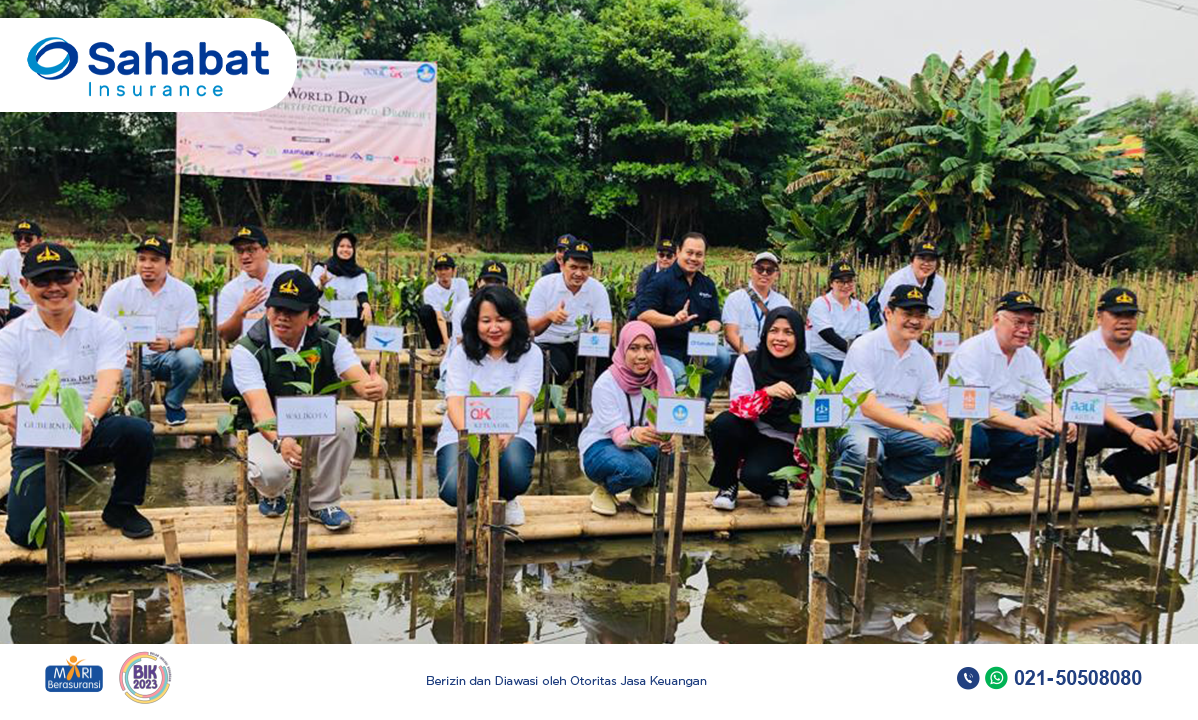
Sahabat Insurance: The International Day to Combat Desertification and Drought.

Terakhir Diubah : 08:36:04 - Sunday, 18 June 2023

Berita - Sahabat Insurance: The International Day to Combat Desertification and Drought. - Sahabat Insurance | Solusi Lengkap Perlindungan Asuransi Anda

In commemoration of The International Day to Combat Desertification and Drought, Sahabat Insurance collaborated with the Trisakti School of Insurance to mitigate natural disaster risks by planting 2,500 mangrove seedlings at Mangrove Forest, Muara Angke, North Jakarta on Saturday, 17 June 2023. Planting mangroves can reduce shoreline erosion and can protect coastal communities from degradation, drought, high winds and waves, and tsunamis.

Berita Lainnya

Essential Checks Before a Long Car Journey

We all know we’re supposed to check our car before we set off on a long journey. But what does that actually involve?
These checks can be done by anyone at any time and will not need any special equipment or prior knowledge.

1.Check Your Tires
There are three elements that you should check:
Appearance
Tread
Pressure

2. Check Your Oil Levels
To check the oil level you will need to remove the dipstick. You should be able to easily locate this as it will be either a bright yellow or orange pull ring.
Once you’ve pulled out the dipstick you should then wipe it clean so that no residual oil remains and could provide a false level.

3. Check The Engine Coolant
It is especially important that this check and top up is done when the engine is cold, and we recommend leaving the vehicle for at least eight hours since it was last used before opening the coolant tank. This is because the coolant can get incredibly hot and with the pressure in the tank opening it when not cool can cause serious injury.

4.Make Sure Your Lights are Working
To check your headlights and high beams face the reflective surface, and turn them on. You can also check your cabin light, and your front fog light, if your vehicle has one.

5.Test Your Brakes
You should also check your brakes are working correctly before setting off.
There are two checks to complete. The first is to press down on the brake pedal before starting the engine, it should feel spongy and not slack at all. Then turn the engine on and conduct the second test. In a safe place you should apply the brakes firmly when driving. The vehicle should stop promptly and not pull to one side.

6.Check your battery
Before you head off you should check that your essential electric systems (battery) are working. A problematic battery will reduce the ability to supply electricity to a number of components, such as lights, wipers, door locks, air conditioners, audio systems and others. The characteristics are easy, these components do not work stably if the battery has a problem.

7.Fill Up
If you’re setting off on a long trip, then you should fill up at the fuel station.
Drivers should refuel their vehicle when they have anywhere between a quarter of a tank or half of a tank left for maximum efficiency.The less fuel in your tank, the greater the risk of running out completely in a bad spot.

For more info about car insurance, please call 021-50508080.

Dengue Hemorrhagic Fever

Dengue Hemorrhagic Fever is a mosquito-borne disease that occurs in tropical and subtropical regions of the world. For mild dengue fever, it will cause a high fever and flu-like symptoms.

Many people have no signs or symptoms of dengue hemorrhagic fever infection. When symptoms do occur, they are mistaken for other illnesses, such as the flu. Usually symptoms will appear from four to 10 days after you are bitten by a mosquito.
This disease can cause a high fever of up to 40 degrees Celsius. In addition, some other symptoms, including:

  • Headache.
  • Muscle, bone or joint pain.
  • Nausea and vomiting.
  • Pain behind the eyes
  • Swollen glands.
  • Rash.
Dengue Fever Prevention
  • Use air conditioning or mosquito nets installed in the vents and beds. In addition, mosquitoes that carry the dengue virus are most active from dawn to dusk, but they can also bite at night.
  • Wear protective clothing when you go to mosquito-infested areas, wear long sleeves, long pants, socks and shoes.
  • Use insect repellents such as permethrin as they can be applied to clothing, shoes, camping gear, and mosquito nets. You can also buy clothes made with permethrin already in them. For skin, use a repellent that contains at least a 10 percent concentration of DEET.
  • Reducing mosquito habitat by closing standing water. Mosquitoes that carry the dengue virus usually live in and around homes, breeding in standing water that can congregate on used car tires. You can help reduce mosquito populations by eliminating the habitats where they lay their eggs. At least once a week, empty and clean containers that contain standing water, such as planting containers, animal dishes, and flower vases. Keep the water container closed between cleanings. (Source: halodoc.com)

vehicle insurance terms

Often confused to see the term vehicle insurance? Don't worry, Friends of Insurance are ready to help with terms that are often used in Vehicle Insurance.
Insurance policy
You may have heard this term many times, but do you really know the meaning behind it? Policy and insurance policy have almost the same meaning, an insurance policy is an agreement or agreement between the policyholder and the insurance company to perform obligations such as loss or damage protection that has been agreed by both parties.
Insurance premium
A word you will also hear often is premium. In short, the premium is the value or nominal payment agreed by the policyholder with the insurance company. The amount of premium to be paid will also be listed on your vehicle insurance policy.
Sum Insured
Simply put, the price of coverage is the purchase price of a motor vehicle when you make an insurance policy. This purchase price will be listed in the policy and will later become the maximum limit of the liability value of the insurance company if you make a claim at any time.
Total Loss Only or TLO
Well, this one term is very closely related to car insurance. Total Loss Only or TLO is one of the most common types of vehicle insurance in Indonesia. If you choose Total Loss Only motor vehicle insurance, it means that in the event of a loss or damage the insurance will provide repair or replacement costs of only 75%.
All Risk
Just like the term TLO, all risk is also related to the type of insurance you can choose for your vehicle. The difference between the two is that all risk insurance will accept all claims for loss or damage to a motorbike or car up to 100%.
Deductible or Own Risk
Deductible, own risk, or own risk have the same meaning, namely the value that becomes your burden for each damage or loss that occurs. This burden or value is usually calculated from the amount of compensation to be paid. As a policyholder you must really pay attention to these details in the insurance policy purchased.
TJH III or Third Party Legal Liability
In simple terms, TJH III talks about the liability guarantee that will be given by the insurance party to a third party if the insured vehicle suffers a loss or damage. You can ask the insurance party for points regarding Third Party Legal Liability when making a policy.
At least you need to understand the terms mentioned above, besides that, pay attention to the points that talk about losses caused by natural disasters, riots or acts of terrorism. Don't forget to read the motor vehicle insurance policy in full and in detail so that you know exactly what protection you have.
If you still want to find out more details or complete information about vehicle insurance, you can find all the information at www.sahabatinsurance.id or call 021-50508080.